LINDBERG
Corporate Entertainment
Consultants and
Producers
MEDIA / REVIEWS
DES AND Dawn Still Truckin'
Liberty Life Theatre on the Square
MARY JORDAN WRITES IN BUSINESS DAY
 "In the arts, the names that trip readily off the tongue are those from New Brighton or The Market Theatre who shaped a dramatic canon with plays of protest: but do not overlook the steady and unrelenting provocation of DES AND DAWN LINDBERG
They started slowly with small, impertinent niggles. On a Sunday evening, downtown Johannesburg was a Calvinist city, starved of nightlife. The Lindbergs opened The Troubadour in Noordt Street so there was somewhere for the rebellious to go. We drank coffee and sang along to Ramblin' Boy and Blowin' in the Wind.
Then the duo took on the Publications Control Board so their production of Godspell could be staged at the Wits Theatre and produced Pippin, which they demanded play to multiracial audiences.
They opened The Black Mikado at Diepkloof Hall in Soweto and always fought vociferously for the rights of theatre managements countrywide, contesting bannings, often facing down the security police.
So you could say that the Lindbergs' cheek and courage were an integral part of my undergraduate life. Yours too, I expect. They were always there, tugging at the heartstrings, or singing their jokey songs like My Dog's Bigger Than Your Dog.
In STILL TRUCKIN' (The Liberty Life Theatre on the Square) you will again walk the long and dusty road with two affable, all-round entertainers who exult in our colourful differences and the profusion of cultures in our land.
In a blend of autobiography, anecdote and random reflection, their chatty style gives present-tense insight into the ways their professional lives have often been obstructed to the point of impossibility. For, while they chronicle the small-scale pleasures of their 40-year marriage and delight in their sons, they also remind us of the function of the conscience and that it is our freedom to exercise it.
They describe SA as a melting pot, a vast stew of energies, a place of great good and unimaginable evil. While they sang their hymns to harmony, Des was instigating litigation on behalf of the black voiceless. Dawn has just never stopped agitating.
So, you are in for a feast of reminiscence with material that is designed to appeal to popular taste. Of course it includes 16 Rietfonteins and The Seagull's Name Was Nelson.
Before you cry "kitsch" or make comments about celebrating the ego, remember that you are looking at a performance that is fabulously, limitlessly, supremely nostalgic; a smorgasbord of the sentimental. You will also subtly be made aware of the efforts and political achievements of the Lindbergs.
"'Tis not in mortals to command success/ But we'll do more, Sempronius - we'll deserve it," wrote Joseph Addison.
The Lindbergs have earned all they have. They are two of local theatre's great hearts, who just never give up on hope.
Buy a ticket, treat your university friends and go back in time to the days when Red Red Wine meant Tassies and a hangover from which you could recover immediately.
The production runs until April 22. Book at Computicket. "
Stage
And now for the next 40 years …
 April 11, 2006 Edition 1
Peter van der Merwe - The Star Tonight
Still Truckin'
Cast: Des and Dawn Lindberg
Venue: The Liberty Life Theatre on the Square
If you're 40 or younger, here's a startling thought for you: the evergreen pair of Des and Dawn Lindberg have been singing for longer than you've been alive, and they're showing no signs of slowing down!
In fact, they're so full of beans that they're currently presenting two shows a day at the Theatre on the Square - the charming children's production, Unicorns, Spiders and Dragons' Tales at 3pm, and following it up at 8.15pm with the retrospective Still Truckin'.
The latter is billed as a celebration of the couple's 40 years of marriage and show business, and is not so much a blast from the past as a gentle meander down memory lane, filled with music, images and witty asides.
The use of a slide show is a master stroke, adding a powerful visual depth to the songs and the narrative.
The Lindbergs have dug deep into their scrapbooks and come up with hundreds of images, from press clippings and old photographs to various collages and computer graphics. It's an extremely effective way of jogging memories and opening the floodgates of nostalgia.
The journey starts back in the early '60s, which is well before the time of most 30- and 40-somethings, but the music is always strangely familiar.
Every decade tells its own story: from the early days of the Troubadour in Doornfontein to the iconic musicals like Godspell and The Best Little Whorehouse in Texas to the famous soirées in Des and Dawn's house in Houghton Ridge through the '90s and into the new millennium.
And unlike the government of the time, which banned albums like Folk on Trek for obscenity, the Lindbergs' music lives on.
They revisit many of their old favourites, including Die Gezoem van die By (Des's first number one hit!), Ramblin' Boy, The Seagull's Name was Nelson and 16 Rietfonteins, weaving them together with warmth and humour.
What makes this show special is that it's not just a rehash of the good old days. The journey runs until today, and it's far from over. Here's looking forward to their 50th anniversary show!
In the meantime, though, take your children (and your parents, for that matter!) to the afternoon showing of Unicorns, Spiders and Dragons' Tales.
Book through Computicket or call the theatre at 011-883-8606. Tickets cost R90 for Still Truckin' and R50 for Unicorns, Spiders and Dragons' Tales.
Rebels with a chord
 Christina Kennedy - The Citizen- 10th April 2006
The couple that plays together stays together. Living proof of this adage comes in the form of Des and Dawn Lindberg, who are celebrating 40 years of marriage and showbiz. They spoke to Christina Kennedy.
It would be easy to label them South Africa's Sonny and Cher, but there's a fundamental difference: veteran folk duo Des and Dawn Lindberg are still in love and still truckin' after 40 years together.
Looking at old black-and-white snapshots, it seems like a far-off time when the dewy-eyed couple met at Wits in the '60s and were soon pitted against the might of the apartheid authorities with their protest songs and defiant musicals.
He was a shaggy-haired folk troubadour with a guitar and flares, and she a statuesque art student in a kaftan with hair down to her waist. With a song in their hearts and the world's social ills on their shoulders, they packed their two cats into a caravan and toured virtually every dorpie in the country. They were rebels - with a cause. Fast forward a few decades, to the present-day post-apartheid SA.
The Lindbergs may seem respectable and sophisticated pillars of society now, but the couple can still muster a frisson of controversy every now and then: Dawn's poster for her production of The Vagina Monologues was banned as recently as a couple of years ago! The times they are a changin', but the more things change, the more they stay the same, it seems…
With the Lindbergs, it was never stirring just for the sake of stirring. True friends of Africa, they not only challenged racial oppression but also helped showcase and promote black talent.
"In the early years we feel we did make some small difference," says Dawn, rather modestly.
The musical Godspell, which featured a multiracial cast, was banned in the '70s but went on to run for a further two years after the Lindbergs won a much-publicised Supreme Court appeal.
"Winning that case was the greatest moment in our careers. We were idealistic, maverick and it was something worth fighting for," recalls Dawn. "We were living for the moment," adds Des.
Nevertheless, life was not all psychedelic hearts and flowers in leftie hippie-land. They had to endure bomb threats, pickets, having their phones tapped and their tyres slashed, and being stalked by members of the Special Branch who were checking for "subversive Commie-inspired material".
Des remembers constantly fighting the censors. "The SABC would put a compass through vinyl records they found unacceptable, issuing orders to, for example, 'trek uit' side two and not allow it on air."
To them, the cultural boycott was a double-edged sword. On the one hand it encouraged the growth of indigenous protest theatre and forced South Africans to look within their own borders for their entertainment.
On the other hand, not being exposed to works and artists of international calibre meant that locals risked becoming didactic and insular.
The marriages of some entertainment couples become casualties of their fame, but Des and Dawn's credo seems to be: viva la difference! They share many interests, yet they perform different roles within the industry.
Des has always been the technical one - writing scripts and lyrics, and doing sound engineering in his digital recording studio. Dawn is the creative one - directing, designing, dancing, painting.
"We complement each other," says Dawn. "There's never been any competition or resentment between us." That's not to say they never disagree: Brokeback Mountain, for example, elicited very different reactions from the pair!
The key to their longevity in the industry, they reckon, is that they've reinvented themselves over the years and learned to diversify and wear various hats - producers, performers, arts administrators and so on.
Des is the current chairman of the Theatre Managements of SA, while Dawn is the executive direc-tor of the Naledi Theatre Awards.
At the moment, they're also back on the stage with Still Truckin', a "musical scrapbook of memories" that takes audiences on a nostalgic trip through not only the Lindbergs' fascinating career, but the social and political upheavals of the past four decades as well. It is being staged at the Liberty Theatre on the Square in Sandton until April 23.
At the same time, their kiddies' show Unicorns, Spiders and Dragons' Tales is running in the afternoons for the school holidays.
They reminisce about the glory days of the "West End of Joburg" - a vibrant theatre zone in the CBD - but acknowledge that those were the days before TV, and that theatre today has to compete with a host of other entertainment options vying for people's disposable income.
So is theatre a dying art form? "I think there is a hunger for real theatre," says Des.
"The theme has changed from political, angry theatre to social commentary and looking back on history," Dawn continues. "And the big franchise musicals are coming back, which are highly seductive to the general public."
She is hoping that as the Naledi Theatre Awards grow (they may be televised next year), they will assist in "making theatre accessible and desirable to a new audience".
Both Des and Dawn are fit and healthy, training regularly at gym. "It sounds cheesy, but we've never done drugs or smoked - although we do love our wine," confesses Dawn. "I don't know how artists can sustain a career if they abuse their bodies."
Says Des: "We've always had pets, we love our family, we love to laugh and we've kept our feet on the ground. And we've never thought of ourselves as a big deal."
What's next for SA's most enduring showbiz couple? With such a rich and eventful life behind them, the natural answer is writing their memoirs - and several publishing companies are reportedly interested.
But one gets the feeling that the Book of Lindberg is far from being closed anytime soon…
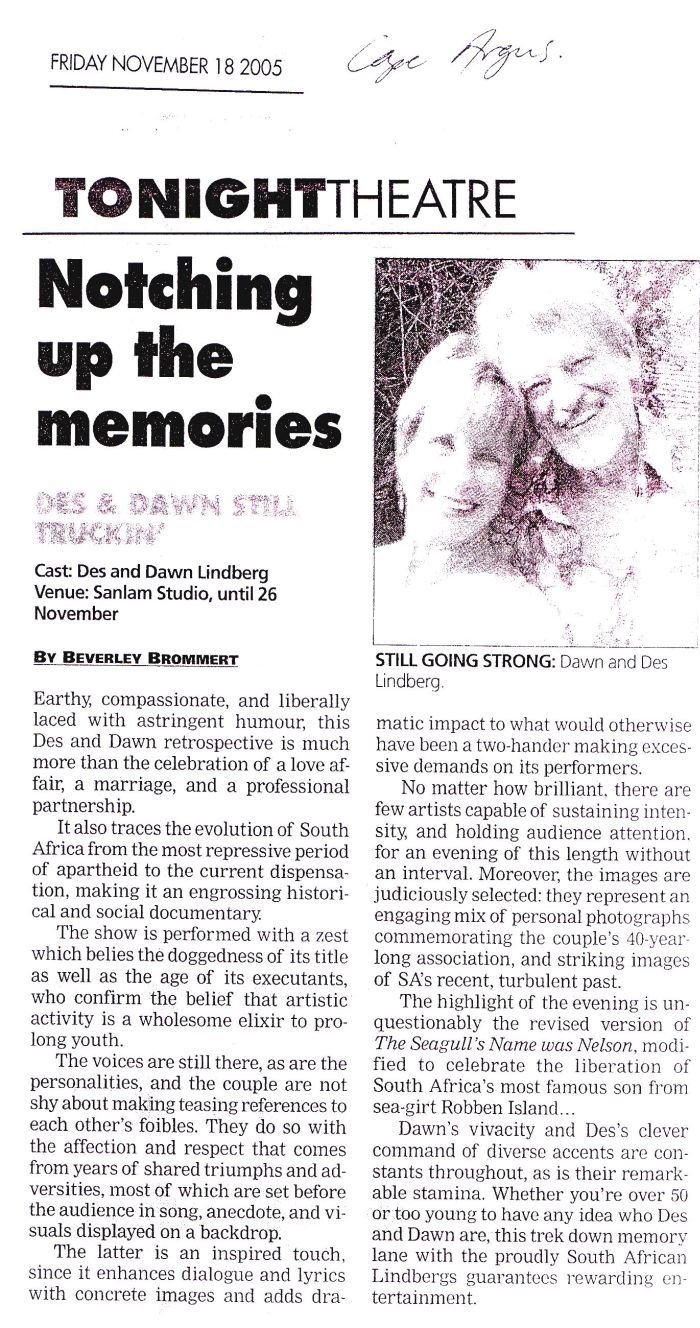
NOSTALGIESE REIS MET DIE LINDBERGS
"Met die inligting beskikbaar … verwag 'n mens 'n kosert met die duo se grootste treffers van die afgelope 40 jaar. Dit kry jy wel, maar nie in die formaat van twee sangers wat op die verhoog staan en die een oorbekende liedjie na die ander sing nie.
Des en Dawn neem jou op 'n nostalgiese reis . Hulle begin met 'n oorsig van wêreldgebeure die afgelope 40 jaar…..jy voel so deel van alles dat dit is asof jou eie fotoalbum in die openbaar oopgeslaan is... 'n mens kry die idée dat Des en Dawn nog lank nog baie te sê gaan hê."
MARIANA MALAN, Die Burger,
17 Nov 2005
"As a biographical account of one of South Africa's most loved duos, Still Truckin' gives excellent insight into the lives of this musical twosome…. these two legends of South African Theatre celebrate 40 years of marriage and show business. … This latest stopover on their folk trek is a humorous reflection on decades of music and laughter, and ultimately a successful partnership… The show plays out against a backdrop of over a thousand digital visuals from the Lindbergs' scrapbooks and archives."
JANE MAYNE, CAPE TIMES,
17TH NOV. 2005